

AI adoption is routinely framed as a technology initiative: select the platform, integrate it, train the workforce. Yet technology is only the solution. Adoption itself is a human challenge, and it is where most AI initiatives either succeed or stall.
This article outlines five lenses leaders can use to approach AI adoption strategically, holding technology and people in equal view.
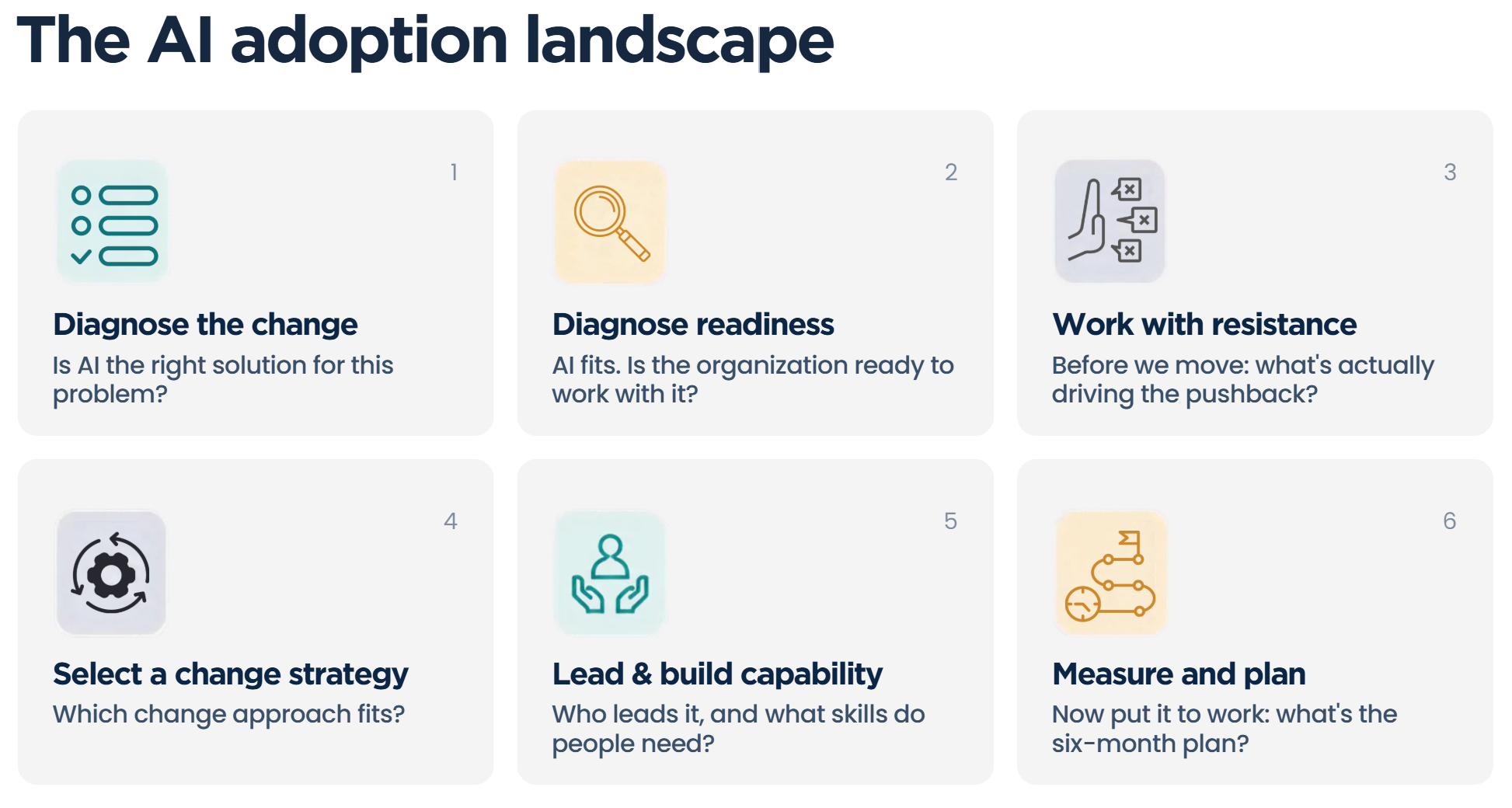
Lens 1: Is AI the right solution?
The first question is not which AI to adopt, but whether AI is the right answer at all. Market momentum is not a business case; the problem must come before the tool. That judgment also requires knowing the landscape: analytical, generative, agentic, and physical AI each solve different kinds of problems.
The next decision is how people and AI will work together. Building on MIT Sloan’s distinction between automation and augmentation (Loaiza and Rigobon, 2024) and Fragiadakis et al.’s (2024) collaboration framework, there are three modes:
AI-centric: AI performs the task on people’s behalf.
Human-centric: People own the task, and AI helps them do it better or faster.
Symbiotic: The task itself changes, and people and AI work as partners in a two-way loop.
Finally, is the goal to enhance an existing process or to redefine it? The answer shapes everything that follows.
Lens 2: Is your organization ready?
Knowing what to build matters only if the organization can sustain it. At its core, AI is a data product. Before adopting it, an organization needs an honest assessment of its maturity: whether it has the data, the technical foundation, and the organizational conditions to sustain AI over time.
Gartner’s AI Maturity Model offers a useful structure for that assessment. It evaluates maturity across seven pillars (strategy, value, organization, people and culture, governance, engineering, and data) and places organizations along five stages:
Foundational: ad hoc experimentation with limited coordination.
Emerging: early pilots and growing executive interest.
Operational: AI embedded in select processes, with defined ownership.
Scaled: AI deployed across functions, with measurable return on investment.
Transformational: AI reshapes decision-making, operating models, and competitive advantage.
Assessing each pillar shows where the organization stands today, where the largest gaps are between current and target maturity, and where to invest first.
Lens 3: Where will resistance show up?
Even a ready organization will meet resistance, and it can emerge at any stage of adoption. It is also one of the most consistent concerns raised by leaders driving AI initiatives, particularly in small and mid-sized organizations outside the technology sector.
It typically takes three forms:
Technical resistance. Insufficient data or integration challenges, including tool mismatch, vendor immaturity, and security and governance concerns.
Capability gaps. The technology is in place, but the workforce is not yet equipped to use it effectively.
Human resistance. The most consequential of the three. AI represents an adaptive change: one that requires people to revisit their beliefs and values before their behavior can change. AI can challenge how people understand their role, their expertise, and their professional identity.
People generally fall into three groups: optimists, skeptics, and pessimists. Each requires a fundamentally different conversation, and an adoption plan designed only for the optimists will lose everyone else.
Lens 4: What change strategy fits?
Understanding resistance raises the next question: how to manage the change itself. Because AI adoption is fundamentally a change management challenge, the choice of change strategy matters. No single model is superior; most organizations need to combine approaches and apply them differently as the change progresses.
Before selecting a framework, it is worth characterizing the change along six dimensions:
Certainty: How clearly defined is the future state?
Unit: What is the primary unit of change: an individual, a team, or the whole organization?
Depth: Is this a technical, adaptive, transactional, or transformational change?
Direction: Is the change driven top-down or bottom-up?
Identity: Does it alter roles, daily work, or how employees see themselves?
Horizon: Is it a contained project, a multi-year transformation, or continuous change?
Together, these answers point toward the right framework, or the right combination of frameworks.
Lens 5: What kind of leader does this need?
Every change strategy ultimately depends on the people leading it. No single leadership style serves the full arc of AI adoption. Effective leaders adapt, drawing on different capabilities as the change evolves, and leadership archetypes offer a useful guide.
Above all, AI adoption calls for emotionally mature leadership and a deliberate investment in psychological safety. People cannot unlearn and relearn in an environment where not knowing feels unsafe.
The bottom line
Across all five lenses, one theme holds. AI adoption is not magic. AI is a data product, and its adoption is a people process. The organizations that succeed will be those that take both seriously.
Which of these lenses presents the greatest challenge in your organization today? Share your perspective in the comments.
Note: AI was used for grammar checking and overall editing. The content is based entirely on the author’s research.