

The current AI is good enough to replace a good slice of the coaching market.
That is an uncomfortable truth to share, especially as a coach myself. I plan to continue coaching for the near future. But after more than a year of experimenting with LLMs for coaching, I can’t frame the answer any other way.
A year ago, if someone had asked me whether AI can do coaching, I would have said it’s not quite there. Today, I would say yes, AI will do coaching. But it will not replace human coaches.
So what does the coaching world look like with AI and human coaches?
For one thing, AI coaches will democratize coaching for a large population. Coaching was originally available only to C-suite and senior-level employees. Now everyone has access to coaching, which is great.
Even for human coaches, it is educating a large part of the workforce about the value of coaching. How many times has a client asked me to just give them answers to fix their problems!
Working with a well-designed AI coach is educating people about what coaching is and how to show up as a client who understands what coaching means.
That said, the progress has been faster than most coaches realize.
My Personal Experience with AI Coaching
I have been experimenting with LLMs for coaching for more than a year now.
I have tried multiple approaches:
I have tried crafting good prompts in ChatGPT using coaching frameworks and principles
Tried a little bit of fine-tuning, realized it’s too much work for too little reward
Tried reasoning and multimodal approaches, they worked fine, but today’s models are so much better than what I experimented with
Played with custom GPTs, that was pretty good!
My initial reaction was: meh, it’s good, but it needs a lot more work!
After the latest release of GPT 5.2 and Claude Opus 4.6 (the earlier version was decent too), the responses were much better.
With the focus on improving reasoning, GPT has become less suited for coaching, in my opinion, than Claude. With the right instructions, Claude does the Socratic style of coaching so well. It was less sycophantic, and sometimes it made me feel as if I was talking to a human who was respecting my instructions. (I added a few coaching models and ICF core competencies in the instructions.)
I am convinced that AI will replace surface-level coaching.
What AI coaching can and can’t do?
So if you are a coach working at the surface level, it is time to upskill and get really good at the coaching skills beyond thinking and pattern matching. Because AI will do that better than you.
But coaching is not about that. It’s not just the questions asked by the coach. It’s not just reframing your negative thoughts. It’s not just asking you to think differently.
There are multiple reasons why AI coaching falls short for deeper work.
It is the personal connection that matters. AI cannot replicate human empathy, at least not fully. AI can replicate cognitive empathy, but not affective or relational empathy. A human coach doesn’t just understand a client’s emotions. They feel them, in their nervous system, in their body, in real time.
A good coach does not just follow a template. They know their tools deeply, but the question or exercise they choose in the moment is far more spontaneous than anything an AI can produce.
AI’s context is limited to what you share with the model or what you bring to the coaching conversation. But a human coach’s context is not just the conversation. It is also the things you did not say, the defensive patterns that keep showing up in real time, the slight shift in your tone, the body language, and the mismatch when you say yes but your body says no. The machine won’t understand that. (One could argue that with different machines capturing image and body sensations, you could automate this too. But that is not possible with the way current LLM models are developed. That is for another article.)
AI does not understand the politics and the shadow dynamics of organizations. A human can sense that, feel that.
And then there is the sycophancy problem. AI is just too nice to you. Claude did a better job than GPT, but it’s still not as good as a human. A good coach knows when to support and when to challenge the client. That decision is sometimes based on the nuances I mentioned above.
And for a quick question about goal achievement, performance, or getting some encouragement to feel good, hell yeah, why not use AI? But for more transformational and constructive developmental coaching, AI won’t be enough, and sometimes it can backfire. You don’t want someone telling you that you are always right when clearly something is not working for you.
How do I use AI in my practice?
I use AI for the operational and mundane parts of coaching. I also use it while I am with a client, if they are comfortable. What it allows me to do is really focus on the client’s story and be truly present with them, with the peace of mind that no detail, like that one project the client mentioned, gets lost. It also helps me go back to the conversation afterward, analyze my coaching, and improve my skills. My inner coaching self is eternally thankful.
I prepare 360s with AI. I still control what goes into the report, but a huge part of the analysis of raw data and structuring is done by AI. That is the primary reason I am able to give 360 analysis as part of my coaching without charging a huge extra fee.
A quick note on data privacy. I am using a custom tool using LLM APIs. I am mindful of data regulations in the regions I operate in. Personally identifiable information is removed before running the model.
The future of coaching!
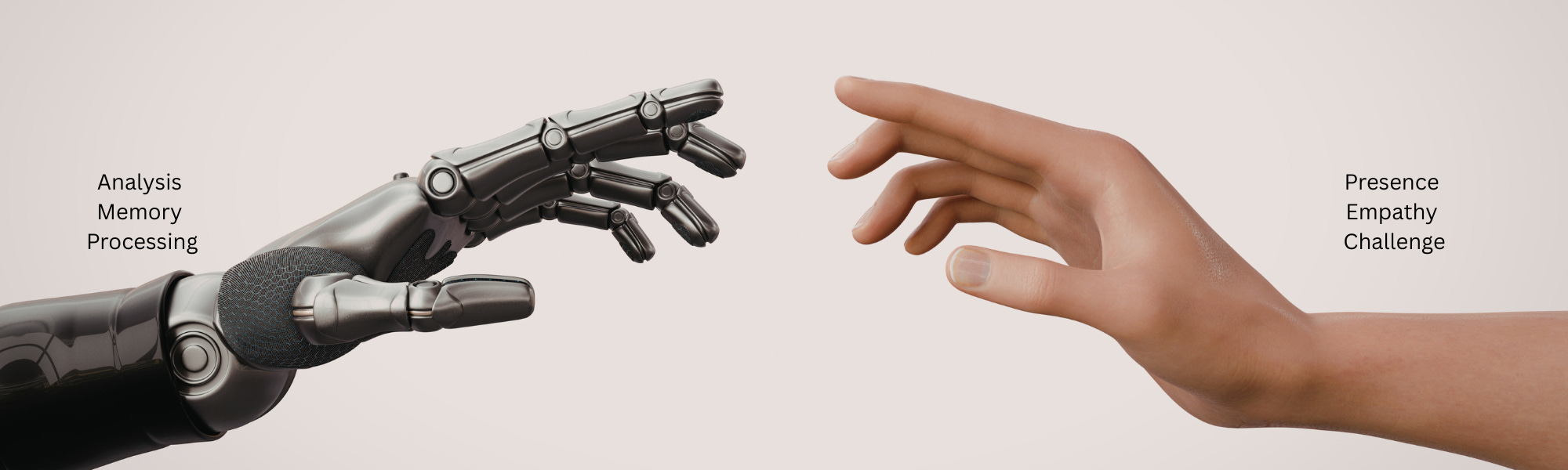
The future of coaching will be a collaboration between humans and AI, and I think it will be a beautiful one. AI is not automating coaching, it is augmenting it. AI will do what it does best: analysis, memory, and processing. Humans will do what they do best: deep listening, presence, and connection.
As McKinsey put it, “Leadership is ultimately a uniquely human endeavor” (McKinsey, Jan 2026). AI won’t change that. But it will change how we support it.
People who have used AI for coaching, what was your experience like? My fellow coaches, where do you draw the line between what AI should and shouldn’t do in coaching?
Note: It is an opinion article