

I recently saw a post from Reid Hoffman saying AI will make careers look more like jungle gyms than ladders.
The first time I came across this idea, that your career is not a ladder but a jungle gym, was in Sheryl Sandberg’s Lean In.
I read the book pretty early in my career, and I don’t think I really understood what she meant at the time. Growing up in a middle-class family in India, my idea of a career was to start somewhere and then grow.
Education + Hardwork = success.
And I did exactly that. I finished engineering, started my career in data, moved to the US. Working in FAANG felt like the ultimate success.
A part of me over-identified with where I worked and what I did. Knowingly or unknowingly, I was treating my career as a ladder, not a jungle gym.
What is different now?
In this new era where AI is interfering with almost every job, the concept of treating your career as a jungle gym matters more than ever.
Because in the AI revolution era, you should not be building resumes. You should be building skills.
The thinking job you are doing today will be done by AI eventually, if not already. Beyond the upskill-reskill talks, this is the reality of it. You really have to hone your skills.
I was reading a book called How to Start by Jodi Kantor, where she describes craft and need.
Craft is your skillset. What you’re really, really good at. Need is what the world needs.
Your job will always be at the intersection of craft and need.
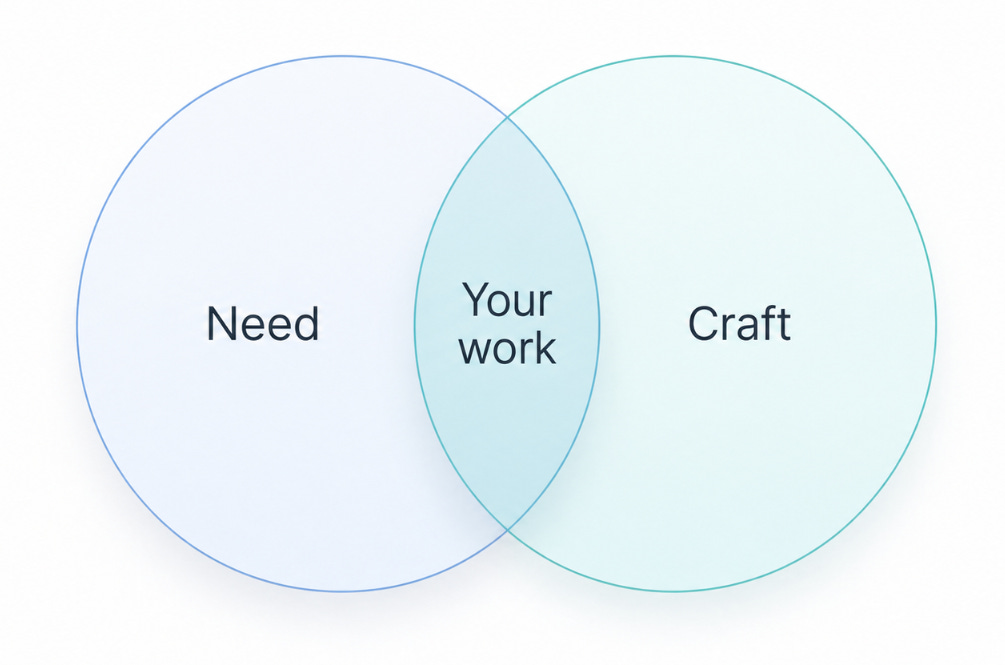
Craft sometimes doesn’t look like part of your job description. You might develop it outside of work. And it doesn’t always show up in resumes. The ATS filter won’t really give value to the craft you’re developing over the years.
According to Kantor, craft is the mastery of knowing how to do something other people don’t. It is built up through skill and expertise, a slow accumulation that may take many years. It is not a trend. It is durable. It is something you develop over the course of your life, through your education and your experience.
Craft lives in you. It compounds. And it gives you a stand, regardless of which company or industry you work in.
Kantor says need is the outward-facing counterpart. It is understanding what the world needs across the decades of your working life.
So craft is internal. Need is external.
Need can change based on what is happening in society. AI is the latest example. Everyone is talking about it. AI fluency is the need for today’s job market.
So how do craft and need relate?
Craft without alignment with need looks like not having a direction. The intersection is where you want to be working.
Kantor also makes the point that chasing need without craft looks like following a trend. It won’t last.
AI is the trend right now, and everyone is adding AI to their resume. But if AI is not what you actually want to do, it won’t be sustainable.
How is this applicable in this AI era?
In an era where AI can pretty much do anything general, your craft is what will differentiate you.
Your craft is yours. It has depth. And critically, it was not in the general data that trained the AI models.
That is why finding your craft matters more than ever. It is the part unique to you. The part the model could not learn from.
The version of me who over-identified with the company name and the title was building a resume. Resumes can be matched, parsed, and reproduced. Craft cannot.
So polish yours. Deepen it. Aim it where the world needs you.