

There’s a new kind of founder emerging in Silicon Valley. They don’t hire a team. They spin up agents.
The Wall Street Journal recently reported on how founders working with AI agents are working more, not less. What stood out to me wasn’t the productivity. It was the isolation. Instead of bringing people in, founders are creating new agents and handing them the work. The company gets built, and the founder is alone in the room.
And the toll is showing up. Founders are reporting burnout, lack of sleep, less connection, and a strange new anxiety: the fear of being the bottleneck for agents that never stop working.
Imagine a founder in a San Francisco apartment. It’s 2am, and the agents are still running. They don’t need a break. Unblocking them feels urgent in a way that eating dinner doesn’t. There’s no co-founder to say “go to bed,” no teammate who notices you haven’t left the house in three days.
This is just the beginning of the future of work. The agents do the work, and you manage them.
What Is Different Now?
Hustle and grind are not new to Silicon Valley. Founders have always pushed themselves past reasonable limits.
But something different is happening now. Humans are wired for peer connection. It’s a biological need, not a nice-to-have. Your co-workers used to meet that need, at least to an extent. The debugging session that turned into a conversation about life. The teammate who’d been through a failed launch and could tell you what it felt like on the other side.
When agents replace your co-workers, you don’t just lose the small talk. You forget how to connect with people, and worse, you stop valuing connection at all. It starts to feel like a waste of time.
Silicon Valley founders are builders and problem solvers, and AI creates infinite opportunities to solve problems.
I’ve noticed this in myself. If someone gives me a challenge now, I don’t say no. I know I can brainstorm with Claude or ChatGPT and come up with a solution. I don’t need to ask anyone for help.
But that convenience strips away the opportunity for vicarious learning. Learning through other people’s lived experience. The kind of learning you can’t get from a model, no matter how good the responses are.
Can Group Coaching Help These Founders?
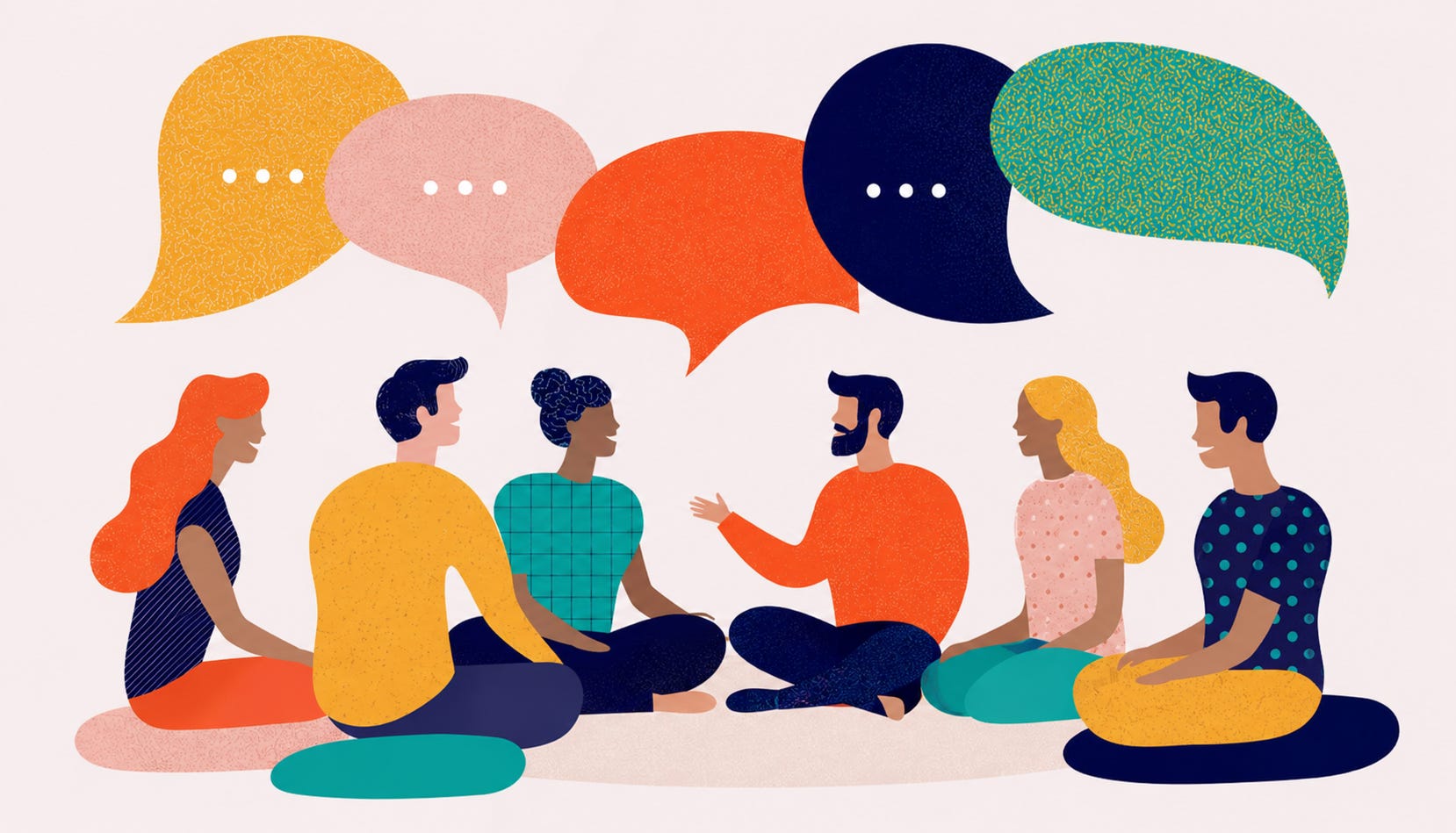
Image generated by AI.
Along with my 1-1 coaching, one of my focus areas is building communities and systems that foster connection and learning. Group coaching naturally fits here. It is grounded in sociocultural theories of adult learning, psychological safety, and systems-level perspectives.
Recently I was reading Erek Ostrowski’s The Capable Group Coach. I was trained as a coach by Erek in a cohort setting at the University of Pennsylvania, so I already believed in the power of group coaching and learning alongside peers. What this book gave me was the specific language and explanations for what that experience did for me as a student, a coach, and an entrepreneur.
So how can group coaching help these Silicon Valley founders?
For founders building in isolation. You’re surrounded by agents all day, and no one actually sees you.
Group coaching meets the fundamental human need for connection. It creates meaningful connections, a space to reflect and gain clarity, and a shared sense of purpose. Participants have the experience of being seen, heard, and understood within a trusted community.
Brainstorming beyond the AI. Your agents are tailored to you. Even when you try to correct for it, the responses bend toward what you want to hear. Your thinking never really gets challenged. A group gives you the chance to brainstorm beyond your agents, with humans who won’t be sycophantic.
In a group, meaning-making happens through other people. Participants use the coach and their peers as sounding boards when they’re stuck. They engage with different viewpoints, constructive challenges, and alternate ways of thinking.
Founders are builders, wired to identify a problem and solve it. But that same wiring can trap you in one way of thinking. A group coaching session helps you break that pattern, because someone in the room spots what you’re not seeing. In one-on-one coaching, insights come from the individual or sometimes the coach. In a group, that’s amplified by every peer in the room, not just the coach.
Vicarious learning. People learn through each other’s experiences, and that matters more now than ever. Chances are, someone else in the room has faced the same problem you’re stuck on. A founder who thinks they’ve hit a wall hears from someone across the table who hit the same wall and found a door. Group coaching is not just additive; it’s generative. The insight one participant shares becomes raw material for everyone else’s growth.
This isn’t just a nice idea. In his own research on entrepreneurial group coaching, Ostrowski found that vicarious learning happens in more than one way. Sometimes it works through empathy, sometimes through challenge, sometimes through simple observation. The entrepreneurs he studied watched their peers make real decisions and hit emotional turning points, and in the process they sharpened what he calls their “theories of effective action,” built stronger professional identities, and landed on new business strategies. Watching another founder navigate a hard decision teaches you something no agent can.
And to every founder who optimizes for speed: learning alongside peers cuts down the time, effort, and risk of figuring everything out through trial and error. Instead of facing every challenge alone, you borrow from the collective experience in the room. Learning from someone who already made the mistake is faster than making it yourself.
Peer accountability. For real learning to happen, people need a space where it’s safe to take risks, admit what isn’t working, and try new ways of thinking out loud. The facilitator of a coaching cohort builds that psychological safety. And with it comes a kind of accountability you won’t find in self-guided learning: in a group, you’re answerable not just to your coach but to everyone in the room. Ostrowski’s observation is simple and human. People don’t want to let their peers down, and that social commitment keeps them showing up, following through, and making steady progress on their goals.
The Point
Let me be clear. I’m not saying AI agents are bad. Agents are good. This is how work is going to get done, and it’s how the next million- and billion-dollar companies will be built. Agents will be embedded into the systems we work in, and for solopreneurs and small startup founders, even more so. You’re optimizing. You’re assigning work to agents instead of hiring humans. That’s the smart move.
There’s already a debate about whether you should keep thinking for yourself instead of outsourcing all your thinking to AI. I’d add something to it. Along with thinking for yourself, you need to keep connecting with other people. Because in this new world, connection with people won’t come naturally. It won’t be built into the environment or the system design. You’ll need external systems to create it for you.
Think about our ancestors. They did physical work all day. They didn’t need a gym membership to be healthy. We do, because the physical work disappeared from our lives and we had to build a system to replace it. The same thing is happening now with our minds and our relationships. You need to exercise your brain to think for yourself. And you need to train yourself to connect with humans, not just interact with machines.
Group coaching is one of those systems. And to be clear about what it is: it’s not team coaching, it’s not a workshop, and it’s not a team-building exercise. It’s also not a cost-saving version of individual coaching. It’s a different form of coaching altogether. You’re getting coached, learning, growing, and finding insights with your peers. The coach is a facilitator. The cohort discovers themselves while helping others discover themselves.
So for the solopreneurs and the leaders running companies filled with agents: you’re all building alone. You don’t have to grow alone too.
You are the CEO of the company. Your agents do the work you assign to them.
And to become an efficient leader, you need to invest in yourself. In your own growth, your self-reflection, and, of course, in connecting with fellow humans.
A note on process: the ideas, opinions, and arguments in this blog are mine, drawn from my own experience and the materials cited. I used AI as an editing partner for structure, grammar, and flow, the same way I’d use a human editor. Every content decision was mine.
The line about no one noticing you haven't left the house in three days is the real cost here, not the hours. Isolation doesn't announce itself, it just quietly redefines what normal looks like until there's no outside reference point left.