

Attachment theory was originally created to explain how children bond with their parents.
Then researchers found the same patterns showing up in romantic relationships. The same dynamics, the same fears, the same strategies, just in a different context.
But it doesn’t stop there. Research now shows that attachment patterns replay in every significant relationship. Including the ones at work.
So what actually is an attachment style? It’s your default way of relating to people in close relationships, particularly under stress. It’s the system running in the background: shaping how you trust people, how you handle conflict, how close you let someone in, and how safe relationships feel to you. It’s your brain’s way of predicting how relationships work, built from thousands of repeated interactions with your caregivers before you had words for any of it.
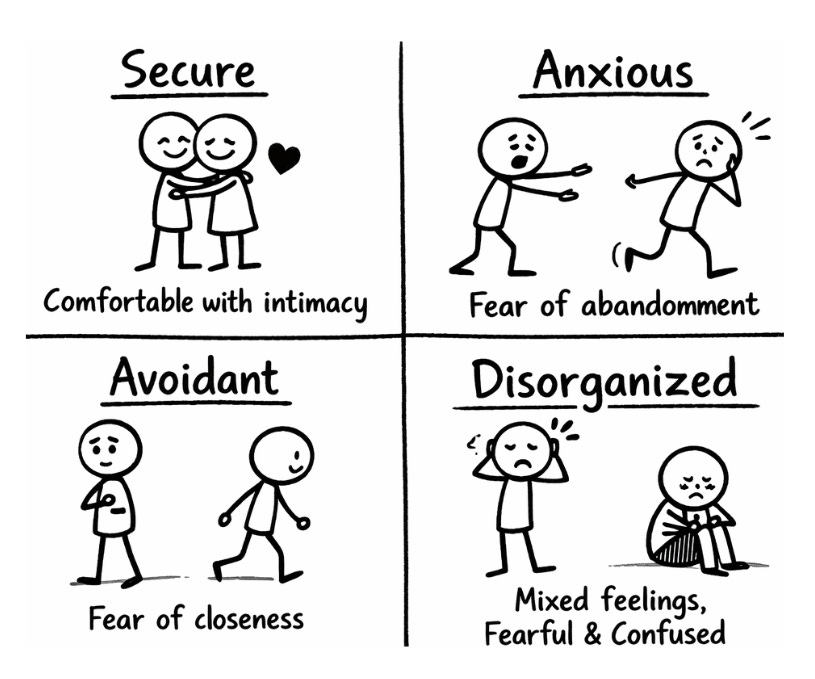
There are four types of attachment styles.
Secure
They’re comfortable being close to people and comfortable being on their own. They trust that people will show up for them, and when they don’t, they can handle it without it unraveling them. Conflict doesn’t feel like the end of the world. Intimacy doesn’t feel like a trap. They can ask for what they need, show up for others, and do both without losing themselves in the process. They still have hard emotions. They just don’t get taken over by them.
What created it: A caregiver who was consistently available. Not perfect, just reliable enough. They showed up, and when they got it wrong, they came back and repaired it. That’s actually the key part, the repair.
In relationships: They can be close without disappearing into someone, and independent without pushing people away. When trust breaks, they can sit with the discomfort, name what happened, and work through it. Conflict is something to solve, not something to survive.
At work and as managers: They give feedback without it becoming personal. They receive it without falling apart. They trust their team enough to actually delegate. As managers, their consistency is their superpower. People around them feel safe, and that safety is what lets everyone do their best work.
Anxious (Anxious Preoccupied)
They want closeness more than almost anything. And they’re terrified of losing it. A shorter reply than usual, a shift in someone’s tone, a cancelled plan, and suddenly they’re reading into it. Their nervous system is always scanning. Always asking, are we okay, are we still okay, what did that mean?
What created it: A caregiver who was inconsistent. Warm and present sometimes, elsewhere other times. They couldn’t predict when comfort would come, so they learned to turn up the volume on their distress signals just to make sure they’d be heard. That hypervigilance got wired in early.
In relationships: Rarely fully at ease, even when things are genuinely fine. They need reassurance, feel it for a bit, and then need it again. Extraordinarily sensitive to other people’s emotional states, which is actually a gift, except when it tips into reading threat into things that aren’t threats.
At work and as managers: Usually the first person to notice when something is off in a team. That attunement is real and valuable. But they can also spiral on an ambiguous email or a quiet meeting room. As managers, they’re warm, invested, deeply loyal to their people. The edge to watch is needing to be liked more than needing to be honest. Hard conversations can get avoided for too long.
Avoidant (Dismissive Avoidant)
They value their independence, probably more than they consciously realize. When things get too close or too intense, something in them pulls back. They find other people’s emotional needs a lot. They’ve probably been called cold or distant at some point, which confused them, because from the inside they were just being fine. Self-sufficient. Not making a big deal out of things.
What created it: A caregiver who wasn’t comfortable with emotional needs. Not necessarily cruel, just dismissive. You’re fine. Stop crying. Figure it out. So they did. They learned to stop asking, stop needing, stop feeling it too loudly. That became their baseline, and eventually it just felt like their personality.
In relationships: Closeness can feel suffocating before they even have words for it. When conflict comes, they go quiet or go analytical, which the other person experiences as disappearing. They don’t mean it as abandonment. But it lands that way.
At work and as managers: Often the calmest person in the room. Decisive, composed, hard to rattle. Those are real strengths. But they’ve also learned to tune out emotional signals, theirs and everyone else’s. As managers, their feedback can be accurate and still land badly because the relational warmth isn’t there. Their team might not tell them when morale is slipping, partly because they’ve learned their manager won’t quite meet them there.
Ambivalent (Fearful Avoidant)
This is the most complicated one, and honestly the most exhausting to live inside. They want deep connection and they’re also braced for it to hurt them. So they move toward people and then pull back. Get close and then create distance. Want to be known and then panic when someone actually starts to know them. It’s not manipulation. It’s two completely opposite survival strategies running at the same time.
What created it: A caregiver who was both the source of comfort and the source of fear. Which meant their nervous system had no coherent strategy. The person they were supposed to run to when scared was sometimes the reason they were scared. That leaves a particular kind of confusion in the body that doesn’t resolve easily.
In relationships: They can go from intense closeness to sudden distance in ways that confuse even them. They might test people without meaning to, expect them to leave before they do, or sometimes push them toward the exit themselves. The longing and the dread occupy the same space. It’s a lot to carry.
At work and as managers: They can be one of the most perceptive people in a room. Their comfort with complexity and contradiction makes them genuinely insightful. But under pressure, the inconsistency shows up. Hot and cold. Deeply present one week, pulled back the next. Their team can struggle to know where they stand, which makes building real trust difficult. Not impossible. Just harder, and it usually requires doing a lot of internal work first.
What this means if you’re a leader
Bowlby described secure attachment as a secure base. The idea is simple: when a child feels safe enough, they’re willing to leave the parent and explore. To take risks. To try things they might fail at.
That same dynamic shows up in entrepreneurship and leadership. Taking risks, tolerating uncertainty, building something from nothing, all of that is easier from a secure base.
That doesn’t mean only securely attached people can build businesses or lead teams. It means your attachment style shapes how you do it. How you handle pressure. How you respond to conflict. How much trust you extend, and how much you can receive.
And here’s what the research is clear on: your attachment style doesn’t just affect you. It affects your team. People perform better with a secure manager. Not a perfect one. A consistent, trustworthy one.
You are not stuck
The goal isn’t to become perfectly secure. It’s to move in that direction. Researchers call this earned security, and people develop it all the time.
It starts with making the pattern visible. Naming it. Understanding where it came from and how it’s showing up now. That alone changes something, because once you can see the pattern, you’re no longer just running it on autopilot.
From there, it’s about finding the relationships and habits that slowly disconfirm the old model. The brain is plastic. It learns from repeated experience. And with enough new experiences that contradict the old predictions, the nervous system starts to update.
Most conversations about healing attachment start with the wound. What was missing, what got damaged, what needs to be fixed. That work matters. But the problem with leading with a purely psychodynamic lens is that it quietly assumes something is fundamentally wrong with the person.
That’s where a positive psychology approach does something different. Instead of starting with the deficit, it starts with a different question: what does moving toward security look like for you, given who you already are?
Because every attachment style carries genuine adaptive strengths, and the research actually backs this up.
Researcher Tsachi Ein-Dor’s Social Defense Theory, published in Perspectives on Psychological Science, found that teams with a mix of attachment styles outperformed more homogeneous ones. Anxious members detected threats early and alerted others. Avoidant members acted quickly and independently under pressure. Secure members managed the complex coordination that held everything together. Each style brought something the others couldn’t.
So anxiously attached leaders bring extraordinary attunement and early threat detection. Avoidant leaders bring composure and decisive action when things get hard. Fearful avoidant leaders bring a depth of perceptiveness that comes from learning very early to read rooms carefully. These aren’t consolation prizes. They’re real capacities, backed by research.
The work isn’t about dismantling who you are. It’s about building enough security that those strengths can operate without the old survival strategies running interference at the same time.
That’s a very different conversation than “here’s what’s wrong with you.”
If this resonated
Understanding your attachment style is one thing. Working with it in the context of how you lead, how you build teams, and how you show up under pressure is another.
That’s the work I do with leaders and executives at Greymahout. If you’re curious about what this could look like for you, visit greymahout.com or reach out to set up a compatibility call.
References
Hazan, C., & Shaver, P. R. (1990). Love and work: An attachment-theoretical perspective. Journal of Personality and Social Psychology, 59(2), 270–280.
Ein-Dor, T., Mikulincer, M., Doron, G., & Shaver, P. R. (2010). The attachment paradox: How can so many of us (the insecure ones) have no adaptive advantages? Perspectives on Psychological Science, 5(2), 123–141.
Ein-Dor, T. (2014). Facing danger: How do people behave in times of need? The case of adult attachment styles. Frontiers in Psychology, 5, 1452.
Davidovitz, R., Mikulincer, M., Shaver, P. R., Izsak, R., & Popper, M. (2007). Leaders as attachment figures: Leaders’ attachment orientations predict leadership-related mental representations and followers’ performance and mental health. Journal of Personality and Social Psychology, 93(4), 632–650.
Popper, M., Mayseless, O., & Castelnovo, O. (2000). Transformational leadership and attachment. The Leadership Quarterly, 11(2), 267–289.
Warnock, K. N., Ju, C. S., & Katz, I. M. (2024). A meta-analysis of attachment at work. Journal of Business and Psychology, 39(6), 1239–1257.
Yip, J., Ehrhardt, K., Black, H., & Walker, D. O. (2018). Attachment theory at work: A review and directions for future research. Journal of Organizational Behavior, 39(2), 185–198.